

Your Kindness Matters

Deenly Blog

Zakah

Zakah: The Quranic Word for Charity That Enriches Both the Giver and the Receiver To the Quranic word Zakah and the meaning it conveys, there is no equivalent in any other language as far as we know. It is not just a form of charity or alms-giving or tax or tithe. Nor is it simply an expression of kindness; it is all of these combined and much more. It is not merely a deduction of a certain percentage from one’s property, but an abundant enrichment and spiritual investment. It is not simply a voluntary contribution to someone or some cause, nor a government tax that a shrewd clever person can get away with. Rather, it is a duty enjoined by God and undertaken by Muslims in the interest of society as a whole. (Learn more about the spirit of charity in Islam.) The Quranic word Zakah not only includes charity, alms, tithe, kindness, official tax, voluntary contributions, etc., but it also combines with all these God-mindedness and spiritual as well as moral motives. That is why there can be no equivalent to the word Zakah because of the supreme originality of the Quran, the Divine Book of God.
Read More »

Pilgrimage

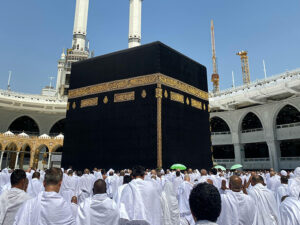
Hajj: The Sacred Journey to Mecca Hajj literally means, “to continuously strive to reach one’s goal.” The Hajj, or Pilgrimage to Mecca, is a once-in-a-lifetime obligation for those who have the physical and financial ability to undertake the journey. The Spiritual Significance The Hajj is essentially a re-enactment of the rituals of the great prophets and teachers of faith. Pilgrims symbolically relive the experience of exile and atonement undergone by Adam and Eve after they were expelled from Heaven, wandered the earth, met again and sought forgiveness in the valley of Mecca. They also retrace the frantic footsteps of the wife of Abraham, Hagar, as she ran between the hills of Safa and Marwa searching for water for her thirsty baby (which according to Muslim tradition, God answered with the well of Zam Zam). Lastly, the pilgrims also commemorate the willingness of Abraham to sacrifice his son for the sake of God. God later substituted a ram in place of his son. Performing the rituals of Hajj provides a reminder of how the great prophets and teachers of faith established a deep and personal relationship with God. As the pilgrim makes his supplications to God, he realizes that He is asking of the same God that answered the prayers of those before him. These reminders are an important part of strengthening one’s faith, trust and dependence in God.

Read More »

Concept of God in Islam

Monotheism, belief in one God, is the most important and foundational concept in Islam. Muslims believe in one God who created the universe and has power over everything within it. He is unique and exalted above everything He creates, and His greatness cannot be compared to His creation. Furthermore, He is the only one deserving of any worship and the ultimate purpose of all creation is to submit to Him. The Islamic understanding of God is distinct from all other religions and beliefs in various respects since it is based on a pure and clear understanding of monotheism. This essentially captures the concept of God in Islam, which will be further elaborated in this pamphlet. Muslims often refer to God as Allah. This is a universal name for God and does not refer to an exclusively ‘Islamic’ God. Interestingly, this name is related to the Aramaic and Hebrew names for God, Allaha and Elohim. Therefore, Allah is simply the Arabic name for God which affirms that He is One singular God with no partners or equals. The name Allah cannot be pluralized or limited to a specific gender, which establishes that God is One and that He is unique from everything He creates. Muslims continue to use this original Arabic name for God (Allah) since it perfectly expresses His unique qualities. God is the Creator and the Sustainer of the universe who created everything for a reason. Muslims believe that He created humankind with a simple purpose – to worship Him. He sent messengers to guide people in fulfilling this purpose. Some of these messengers include Adam, Noah, Abraham, Moses, Jesus, and Muhammad, peace be upon all of them. They all taught a consistent message about God by affirming His greatness as the Creator and guiding people to worship Him alone. This basic concept has always resonated with people’s natural understanding of God.

Read More »

What is Islam

Understanding Islam Islam is the name of the religion that Muslims follow. People who practice Islam are called Muslims, just like those who practice Christianity are called Christians. The literal and lexical meaning of Islam means submission. Islam comes from the root Arabic letters s-l-m which are the same root letters the word peace (salam) comes from. The term Islam itself does not mean peace, but it implies that one finds peace (salam) through submission (islam). The term Arab is often used interchangeably with Muslim, but this is incorrect. Arab is a race while Islam is a religion. Not all Arabs are Muslim and most Muslims are actually not Arab. Arabs make up about 13% of the Muslim population. A Closer Look at the Religion and its Distinction from Arab Identity Islam is named after the action of submitting to God’s commands and will and not a person. Other religions are often named after a person or people. For instance, Christianity is named after Christ, Judaism is named after the tribe of Juda, and Buddhism is named after Buddha. Islam is not name after Muhammad because Islam existed before him. The message of previous Prophets, such as Adam, Abraham, Noah, and Moses was to submit (islam) to God. Hence, the message of Islam did not start with the Prophet Muhammad peace be upon him. It started with Adam and continued until today. With the passing of time, God would send new Prophets and Messengers to remind mankind of His message, to worship Him alone. Muhammad peace be upon him is the last of these Prophets.

Read More »

10 Things You Might Not Know About Jesus in Islam

Many people are surprised to learn that Muslims believe in Jesus peace be upon him. One who reads the Quran will quickly realize that it does not only speak of who Jesus was, it also teaches who he wasn’t. The Quran is a confirmation of the scriptures revealed to previous Prophets. This article will highlight 10 things you may have not known about Jesus, peace be upon him in Islam.

Read More »

The Concept of Thankfulness in Islam

According to Islam, one of our foremost duties is to be grateful to God for all of His blessings. We can describe three levels of thankfulness: To realize and appreciate all blessings by and within the heart. To say thanks with the tongue. To express gratitude by doing righteous deeds. In other words, the first level is the appreciativeness and gratefulness that we feel in our hearts. Then we fortify that thankfulness through our speech. And the third level is when we prove by our deeds that we are truly thankful to God.

Read More »
Quick Charity