
Your Kindness Matters

Deenly Blog

How the Quran’s Sound Carries Its Meaning

We’ve all felt how certain sounds affect us, nails on a chalkboard make us cringe, a baby’s laugh makes us smile. The Quran takes this human instinct and builds an entire sacred text around it, using sound as a direct channel to meaning. For many outside the Islamic faith, the Quran is often referenced but seldom understood in its depth. To Muslims, it represents something far more profound: the literal word of God, revealed in Arabic to the Prophet Muhammad over 1,400 years ago. While its spiritual guidance forms its core, the Quran also stands as a remarkable work of language where every syllable is chosen with divine precision. This careful attention extends beyond the written word into the very sound of its recitation, creating an immersive experience where hearing becomes understanding, and sound conveys soul. The Quran is not merely meant to be read; it’s meant to be heard, and in its hearing, to be felt deeply. That is why Muslims recite the Quran in a melodious tone; they don’t just read it.

Read More »

The Literary Fingerprint: Who Authored the Quran?

For centuries, a central question has intrigued scholars and skeptics alike: Who wrote the Quran? To many Muslims, the answer is a matter of divine revelation; the text is the literal word of God, transmitted through the Prophet Muhammad, peace be upon him. To others, particularly a non-Muslim audience, a more natural explanation might be that the Prophet Muhammad, peace be upon him, was the author. But what if we could apply a modern, objective test to this ancient text? What if we could analyze its literary DNA?

Read More »

Shahada(Faith)

Islam is the name of the religion that Muslims follow. People who practice Islam are called Muslims, just like those who practice Christianity are called Christians. The literal and lexical meaning of Islam means submission. Islam comes from the root Arabic letters s-l-m which are the same root letters the word peace (salam) comes from. The term Islam itself does not mean peace, but it implies that one finds peace (salam) through submission (islam). The term Arab is often used interchangeably with Muslim, but this is incorrect. Arab is a race while Islam is a religion. Not all Arabs are Muslim and most Muslims are actually not Arab. Arabs make up about 13% of the Muslim population.

Read More »

Prayer

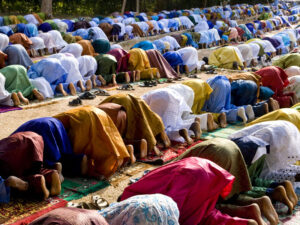
The Five Daily Prayers: A Brief Overview God has ordered Muslims to pray at five set times of day: Dawn, before sunrise: Fajr. Midday, after the sun passes its highest point: Dhuhr. The late part of the afternoon: Asr. Just after sunset: Maghrib. Late evening: Isha. Prayer Sets the Rhythm of the Day This prayer timetable gives Muslims a pattern for their day. In Islamic countries, the public call to prayer, or Adhan, from the mosques sets the rhythm of the day for the entire population, including non-Muslims.

Read More »

Zakah

Zakah: The Quranic Word for Charity That Enriches Both the Giver and the Receiver To the Quranic word Zakah and the meaning it conveys, there is no equivalent in any other language as far as we know. It is not just a form of charity or alms-giving or tax or tithe. Nor is it simply an expression of kindness; it is all of these combined and much more. It is not merely a deduction of a certain percentage from one’s property, but an abundant enrichment and spiritual investment. It is not simply a voluntary contribution to someone or some cause, nor a government tax that a shrewd clever person can get away with. Rather, it is a duty enjoined by God and undertaken by Muslims in the interest of society as a whole. (Learn more about the spirit of charity in Islam.) The Quranic word Zakah not only includes charity, alms, tithe, kindness, official tax, voluntary contributions, etc., but it also combines with all these God-mindedness and spiritual as well as moral motives. That is why there can be no equivalent to the word Zakah because of the supreme originality of the Quran, the Divine Book of God.

Read More »

Pilgrimage

Hajj: The Sacred Journey to Mecca Hajj literally means, “to continuously strive to reach one’s goal.” The Hajj, or Pilgrimage to Mecca, is a once-in-a-lifetime obligation for those who have the physical and financial ability to undertake the journey. The Spiritual Significance The Hajj is essentially a re-enactment of the rituals of the great prophets and teachers of faith. Pilgrims symbolically relive the experience of exile and atonement undergone by Adam and Eve after they were expelled from Heaven, wandered the earth, met again and sought forgiveness in the valley of Mecca. They also retrace the frantic footsteps of the wife of Abraham, Hagar, as she ran between the hills of Safa and Marwa searching for water for her thirsty baby (which according to Muslim tradition, God answered with the well of Zam Zam). Lastly, the pilgrims also commemorate the willingness of Abraham to sacrifice his son for the sake of God. God later substituted a ram in place of his son. Performing the rituals of Hajj provides a reminder of how the great prophets and teachers of faith established a deep and personal relationship with God. As the pilgrim makes his supplications to God, he realizes that He is asking of the same God that answered the prayers of those before him. These reminders are an important part of strengthening one’s faith, trust and dependence in God.

Read More »
Donate Now