

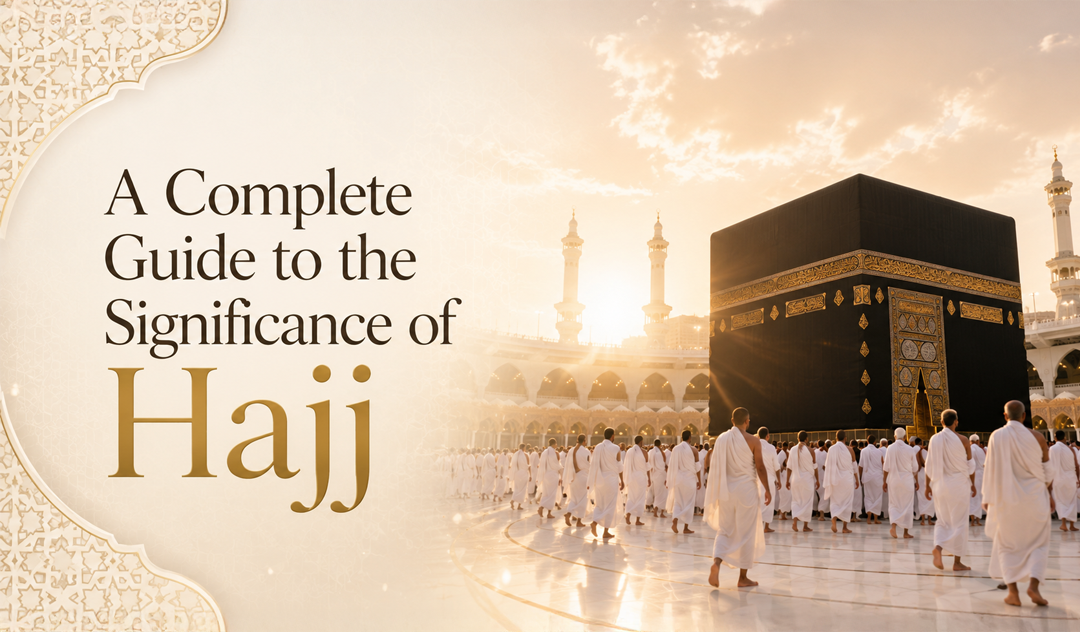
Hajj is one of the five pillars of Islam. It refers to the journey to the holy city of Makkah in the month of Dhul Hijjah. It is a religious event in which millions gather to perform rituals of worship.
Hajj also connects the pilgrims to the past and future by following the teachings and practices of our beloved prophets. It includes Hazrat Ibrahim AS, Hazrat Ismail AS, and Prophet Muhammad PBUH.
Call ˹all˺ people to the pilgrimage. They will come to you on foot and on every lean camel from every distant path
(Quran: 22,27)
Importance of The First 10 Days of Dhul Hijjah
The first days of this Islamic month are blessed and hold great spiritual significance.
Here are several acts of worship that Muslims can offer:
- Doing dhikr and making lots of dua
- Reciting the Quran
- Seeking forgiveness
- Charity
- Performing night prayers
- An increase in righteous deeds
- Special supplication on the Day of Arafah
Here are some important factors to keep in mind when preparing to go on Hajj:
- Prepare spiritually
- Travel documents and paperwork
- Plan accommodation and transportation
- Ihram clothing
- Prayer essentials
- Personal supplies
- Medications and a first aid kit
- Snacks
Major Stations of The Hajj
Hajj comprises several actions that the pilgrims must complete in Makkah. They then visit other major locations such as Madina, Mina, Arafah, and Muzdalifah.
The journey begins with the pilgrims wearing a special garment called the Ihram.
˹Commitment to˺ pilgrimage is made in appointed months. Whoever commits to ˹performing˺ pilgrimage, let them stay away from intimate relations, foul language, and arguments during pilgrimage. Whatever good you do, Allah ˹fully˺ knows of it. Take ˹necessary˺ provisions ˹for the journey˺—surely the best provision is righteousness. And be mindful of Me, O people of reason!
(2:197)
The days of Mina and the Day of Arafah hold great importance during Hajj. The pilgrims spend a day in Mina on the 8th of Dhul Hijjah, before proceeding to Arafah. From Arafah, they travel to Muzdalifah and spend the night before returning to Mina.
On the 10th of Dhul Hijjah, pilgrims perform the sacrifice of an animal for the sake of Allah. They trim or shave their hair and throw pebbles at the designated station in Mina.
The 18 Steps of Hajj at a Glance
Performing Hajj involves a specific series of acts that must be done in the right order. This checklist serves as a quick roadmap for pilgrims, covering everything from entering the state of Ihram to the final farewell tawaf.
By following these steps, a person ensures they fulfill all the requirements of this pillar of Islam. It is a helpful way to stay organized and focused during a very busy and spiritual time.
Step: 1
Preparation and intention
Step: 2
Entering into the state of Ihram (the state of purity)
Step: 3
Performing Tawaf 7 times
Step: 4
Safa and Marwa (completing laps of the two hills)
Step: 5
Trimming or shaving head hair (Umrah ends)
Step: 6
Resting and praying
Step: 7
Re-entering the state of Ihram
Step: 8
Reaching Mina
Step: 9
Day of Arafah
Step: 10
Arrival in Muzdalifah
Step: 11
Rami (stoning of the devil)
Step: 12
Performing Qurbani/Udhiyah and celebrating Eid al-Adha
Step: 13
Shaving the head
Step: 14
Tawaf al-Ifadha and Saai’
Step: 15
The second day of stoning
Step: 16
Spending the night in Mina
Step: 17
The third day of stoning
Step: 18
Tawaf al-Wida
Understanding The Daily Actions of Pilgrimage
To truly appreciate the beauty of this journey, one must look closely at each action. From the moment a pilgrim makes their intention, every movement carries a deep spiritual meaning.
Understanding these details helps a person perform their duties with more focus, turning each physical step into a sincere act of worship.
Preparation and Intention
Before the pilgrims arrive at Makkah to begin Hajj, it is important to make the intention (niyyah) within the heart.
The intention must be to perform Hajj for the sake of Allah and not for any kind of worldly gains.
Entering the State of Ihram
The state of Ihram means wearing a white cloth, wrapped around your shoulder and one around your waist (for men). Women may wear any clothing of their choice, but they must observe hijab rules.
When millions of pilgrims gather in Makkah, everyone stands equal before Allah. In the state of Ihram, one has to be mindful of one’s behavior and words. They avoid the following:
- Smoking
- Engaging in prohibited actions for men and women
- Swearing
- Shaving hair
- Trimming nails
- Using scented soaps or perfumes
Performing Tawaf 7 Times
Tawaf refers to walking in circles around the Ka’bah in an anti-clockwise motion. One tawaf is made of seven complete circuits, each one starting and ending at the black stone.
You can also offer voluntary prayers.
Safa and Marwa (Completing Laps of the Two Hills)
Sa’i begins on the hill of Safa and continues as a walk to the hill of Marwa. There is a green marker (a point) where pilgrims run to the next green marker, then continue walking until they reach Marwa. This makes one lap. Pilgrims then return to Safa to complete the second lap. Sa’i gets completed after performing seven laps.
This is in memory of the wife of Prophet Ibrahim AS, Bibi Hajra, and her struggle in the desert in search of water for Prophet Ismail AS.
Trimming or Shaving Head Hair
Men shave or trim their hair, while women trim their hair to fingertip length. This signals the end of Umrah.
Resting and Praying
After performing Umrah, pilgrims stay in Makkah to complete their Hajj journey. The Hajj begins on the 8th of Dhul Hijjah.
Re-Entering the State of Ihram
The 8th of Dhul Hijjah marks the beginning of the days of Hajj. Once you are all set to enter the Ihram, start reciting the Talbiyah.
Talbiyah:
لَبَّيْكَ اَللَّهُمَّ لَبَّيْكَ – لَبَّيْكَ لَا شَرِيكَ لَكَ لَبَّيْكَ – إِنَّ الْحَمْدَ وَالنِّعْمَةَ لَكَ وَالْمُلْكَ – لَا شَرِيكَ لَكَ
(Here I am, my Lord, here I am
Here I am. You have no partner.
Here I am, Praise, grace, and the kingdom is for You.
You have no partner)
Reaching Mina
Once you arrive in Mina, you will be in your allocated tent. Here, the pilgrims offer prayers including Dhuhr, Asr, Maghrib, Isha, and Fajr (reducing four-unit prayers to two units each), as mentioned in the Quran.
Day of Arafah
After sunrise, the pilgrims proceed to the plains of Arafah. The pilgrims combine shortened Dhuhr and Asr prayers.
Arrival in Muzdalifah
After sunset, pilgrims leave Arafah and reach Muzdalifah to pray Maghrib and Isha combined.
Rami (Stoning of the Devil)
The 10th of Dhul Hijjah is also called Yaum al-Nahr or the Day of Sacrifice (Qurbani).
After performing Fajr Salah, pilgrims depart Muzdalifah and go back towards Mina, reciting the Talbiyah.
Performing Qurbani/Udhiyah and Celebrating Eid al-Adha
Eid al-Adha is also celebrated by Muslims who are not on pilgrimage on the 10th of Dhul Hijjah.
Note: Udhiyah means an animal sacrificed for the sake of Allah. It is another word for Qurbani.
Shaving the Head
After shaving or trimming hair, pilgrims may leave the state of Ihram and wear comfortable clothing.
Tawaf al-Ifadha and Saai’
The pilgrims then go to Makkah to perform Tawaf al-Ifadha and Saai’ as part of the Hajj rituals.
With its completion, the pilgrims return to the tents in Mina and continue with the remaining rituals of Hajj.
The Second Day of Stoning
It is also called Rami. On the 11th Dhul Hijjah, the pilgrims begin with Jamarah al-Ula (the small pillar), then Jamarah al-Wusta (the second/middle pillar), and finally, Jamarah al-Aqaba (the third/large pillar).
Spending the Night in Mina
After completing the second Rami, pilgrims return to the Mina camps.
The Third Day of Stoning
On the afternoon of 12th Dhul Hijjah, pilgrims have 21 pebbles and follow the same procedure as the day before.
Tawaf al-Wida
Before departing from Makkah, this is the final step to complete Hajj.
Ending Note
Hajj is not only a religious journey, but it also resets your mindset. Hajj develops essential values such as unity, equality, universality, unity of purpose, togetherness, selflessness, and sharing. By understanding the rituals and historical connections of Hajj, we can build a stronger, more compassionate global community.
It is a life-changing event that cleanses the soul and brings people closer to their Creator. By completing these sacred rites, a person returns home with a fresh start and a stronger faith.